Why Smart Kids Guess at Words: The Hidden Cause
November 27, 2025

“House becomes horse. Farm turns into from.”
You have likely seen it happen: Your child looks at a word, pauses (or maybe doesn’t), and makes a guess based on the first letter. Sometimes the guess makes sense in the sentence, but often it doesn’t.
It can be confusing to watch. You know your child is bright and motivated, so why are they guessing instead of just reading the word that is right there on the page?
The answer isn’t laziness. It has nothing to do with “trying harder.” It is usually a sign that specific core reading skills haven’t fully clicked yet—and until they do, guessing is the only tool they have left.
Signs Your Child Is Guessing at Words Instead of Decoding Them
– Your child glances at the first letter, then says a different word that starts the same way.
– They make close substitutions like black → back or friend → fried.
– They pause mid-sentence, then blurt out a word that “fits” the story but isn’t on the page.
– Sometimes they sound confident in their guess, making it harder to know they’re wrong.
At first, this strategy may not seem like a big deal. Over time, it starts to create real barriers to reading growth and will eventually, often grade 3 or 4, lead them to hit a wall where reading becomes almost pointless due to the lack of meaning coming from that style of reading.
What Reading Specialists Observe About Word Guessing
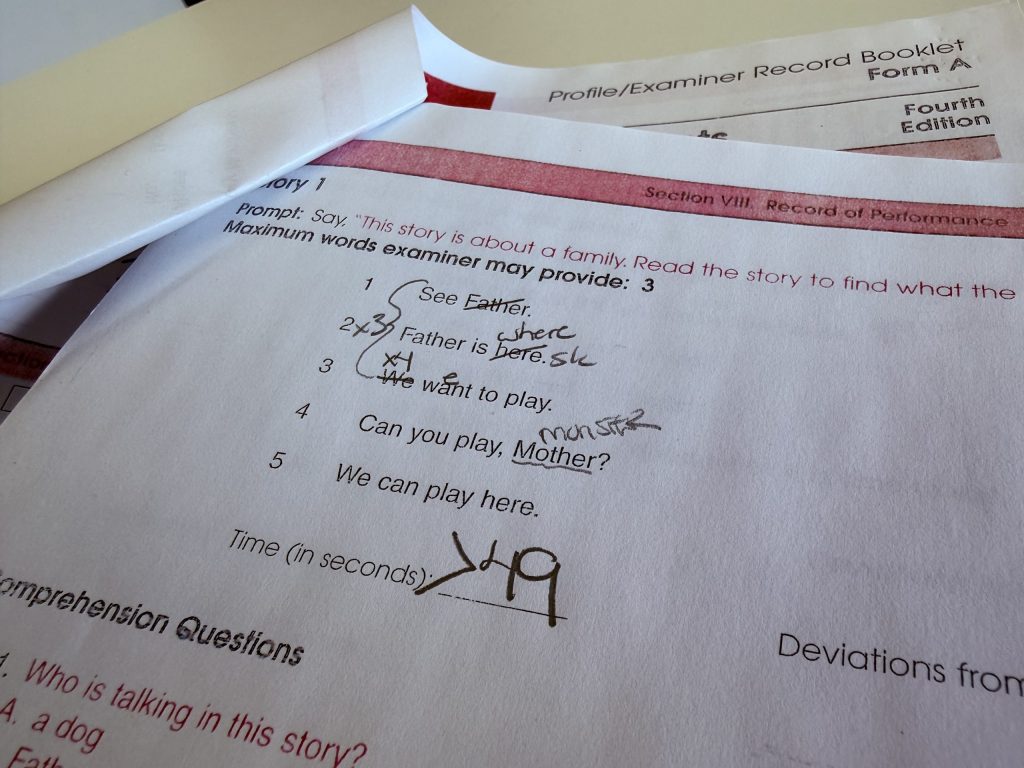
When we were testing this student, she lacked the sight vocabulary and decoding ability to achieve fluency. As a result, she was left to guess at the words on the page. When students guess, they will almost always insert a word that starts and ends with the same letters. House – horse, sleep – slip, mother – monster (we joked about this with her mom). The guesses are obviously incorrect and that leads to a story that makes no sense. When bright students discover they have read something that made no sense, and they know it was written to make sense, they go back and re-read it, looking for meaning. The re-reading a second or third time is time consuming and it impacts their reading rate. If fluency, which is reading efficiency, is the result of reading rate (your speed) and accuracy (number of errors) then significant errors and multiple attempts at reading the passage, will lead to a lack of fluency. Poor fluency means you are less efficient. The less efficient a process is, the more effort is takes to accomplish the task and the more energy you are required to use to just read the words on the page, the less energy there will be to take meaning, comprehension, from what you just tried to read. Students like these will literally be working two and three times as hard as their peers to read the words and taking almost nothing from the words. Any process that takes far more work than it should and yet you still achieve a poor result, is going to be something that almost any person, but especially kids, will have a serious dislike for.
The Root Causes Behind Word Guessing in Children
Weak Sound–Symbol Connections
Strong readers match letters and letter groups (graphemes) to the sounds they represent (phonemes). When this connection is shaky, children don’t trust themselves to sound a word out. Guessing feels quicker and safer.
Reliance on Memory or Context
Some children have strong visual memory. They may remember how a word looks or try to figure it out from the story. This can work with simple or familiar books, but it falls apart as vocabulary grows.
Missing Confidence in Decoding
Sounding out takes effort — and if it hasn’t been taught or practiced in a way that “sticks,” kids may feel it isn’t worth the struggle. Guessing becomes a habit that avoids the harder work of decoding.
Why Guessing at Words Holds Smart Kids Back from Real Progress
– Accuracy suffers. If a child says house instead of horse, the meaning changes. Small shifts add up, and comprehension breaks down.
– Confidence dips. When children aren’t sure if they’re right, they start to feel less capable as readers.
– Progress stalls. Guessing doesn’t scale. As books get harder, unfamiliar words appear more often, and the strategy collapses.
This is why guessing isn’t just a “phase” kids grow out of. Left unchecked, it can become a roadblock that makes every subject harder.
How Novaread Targets the Root Cause of Word Guessing
This kind of guessing usually comes down to gaps in sound–symbol connections and decoding skills. At Novaread, we strengthen those skills through our Seeing Stars® program, which builds the visual and auditory processing children need to connect letters and sounds confidently.
When those connections are strong, guessing disappears, accuracy improves, and reading starts to feel easier — and far less frustrating.
How Psychoeducational Testing Identifies Decoding Gaps
In assessments, children who guess at words show a consistent profile:
– On word identification tasks, they make substitutions that sound or look close, but aren’t accurate.
– They may read familiar words correctly but break down quickly with less common ones.
– They often can’t tell if what they said matches the word on the page.
These results point to the same root issue parents notice at home: decoding isn’t automatic yet.
The Good News: Decoding Skills Can Be Taught
The most important thing to know is that this problem isn’t about intelligence, effort, or attention span. It’s about specific reading skills that can be taught, strengthened, and practiced.
When children develop solid sound–symbol connections and gain confidence in decoding:
– Guessing disappears.
– Accuracy improves, which lifts comprehension.
– Reading becomes smoother, faster, and less frustrating.
Parents often notice a shift not just in reading ability, but in their child’s attitude: kids who once avoided books start picking them up with confidence.
What Parents Can Do When Their Child Guesses at Words
If your child guesses at words instead of reading them, it’s not a sign of laziness. It’s a sign that some of the building blocks of reading aren’t fully in place yet. With the right support, those building blocks can be strengthened — and the habit of guessing can be replaced with true reading.
Your child has the ability. They just need the tools.
Ready to Help Your Child Stop Guessing and Start Decoding?
You don’t have to wait for the next report card to see if it gets better. If you recognize these signs in your child, let’s find out exactly which skills are missing.
Reach out so we can listen to your concerns, answer your questions and if we can help, we can take the next steps toward making reading easier — and more enjoyable — for your child.