Seeing Stars and Orton-Gillingham: Choosing the Right Reading Program in Halifax & Bedford
June 22, 2026
After your child’s psycho-educational assessment, the report likely arrived with a recommendations section listing several options to explore. If Orton-Gillingham and Novaread were both among them, you may be wondering what the difference is. It’s a fair question — and the two aren’t quite the same kind of thing. Orton-Gillingham is a program: a specific, well-established method for teaching reading. Novaread is an organization — one that draws on a range of programs to build the right solution for children with diverse learning needs. Often, the program we’ll use is Seeing Stars®.
For many of the students we work with across Halifax and Bedford, we reach for Seeing Stars — not because OG is weak, but because it’s strong where OG is strong and stronger still in the one place reading most often breaks down: fluency.
Here’s how the two compare, and how we help families decide.
What Orton-Gillingham Is — and Why It’s So Widely Recommended
Orton-Gillingham (often shortened to “OG”) is a structured, sequential, multisensory approach to reading. In plain terms, it teaches the code of written language — the relationships between letters and sounds, the rules that govern them, and how to blend those sounds to decode words. It’s explicit, it’s well-organized, and it builds skills in a deliberate order so nothing is skipped.
For a child who struggles with phonemic awareness (hearing and manipulating the individual sounds in words) and decoding (sounding words out), this is genuinely valuable work. Orton-Gillingham has helped countless students with dyslexia learn to read words they couldn’t read before, and it remains a respected standard for good reason. When a psychologist recommends OG, they are pointing you toward a real, research-supported path.
The Gap Between “Sounding It Out” and Reading Fluently
This is the main reason we rely on Seeing Stars rather than Orton-Gillingham when we build literacy programs for many of our students.
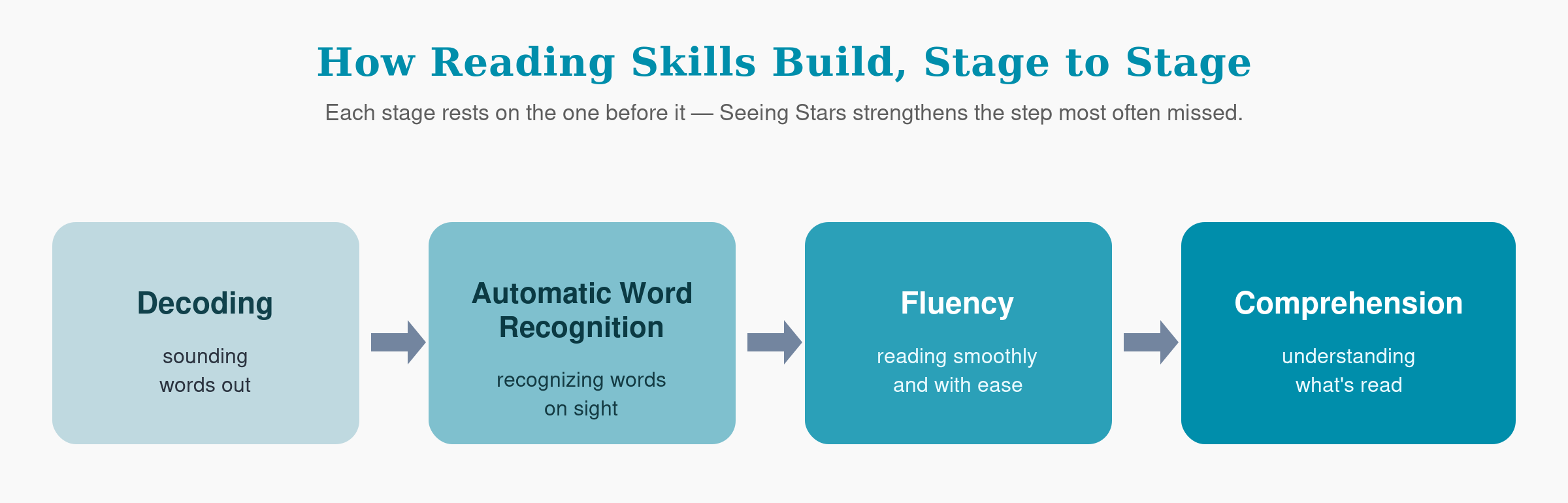
Learning the rules of language and learning to read fluently are not the same skill. Orton-Gillingham is exceptional at the first. But fluent reading — reading quickly, accurately, and with enough ease that comprehension can happen — depends on something more: the brain’s ability to recognize words automatically, without consciously stopping to apply a rule each time.
Reading researchers call this automatic word recognition — and a key part of getting there is the ability to hold letters and whole words in the mind’s eye, so they’re recognized instantly rather than rebuilt sound by sound. It’s what lets a strong reader glance at a word and simply know it, the way you recognize a familiar face. Seeing Stars develops this skill directly; it calls it symbol imagery.
Here’s the tension: a rules-based approach asks the reader to apply knowledge consciously. That’s the right place to start, and it’s essential. But if a child continues to lean on consciously sounding words out, reading stays effortful and slow, even when it’s accurate. The mental energy goes into decoding the words, leaving little left over for understanding the sentence. A child can master the phonics rules and still read haltingly — accurate, but not yet fluent — because the missing piece isn’t more rules. It’s automaticity.
What Seeing Stars Is — and Why We Reach for It
Seeing Stars® is a sensory-cognitive reading program, developed by Lindamood-Bell. In plain terms, it builds symbol imagery — the ability to picture letters and whole words in the mind’s eye — so words are recognized instantly rather than rebuilt sound by sound each time. It works on the same foundations Orton-Gillingham does (sounds, letters, spelling patterns), then goes a step further by training the brain to hold an image of words, which is what makes reading fast, accurate, and automatic.
For the child who can sound words out but still reads slowly, loses their place, or can’t seem to hold onto “tricky” words from one page to the next, this is frequently the missing link. It’s strong where OG is strong, and it builds the fluency that rule-by-rule decoding alone tends to plateau on. That’s why, for many of the students we work with, Seeing Stars is the program we reach for — not as a rejection of Orton-Gillingham, but as a deliberate choice to lead with the approach we’ve seen move the needle most on the outcome parents care about: a child who can pick up a book, read it, and enjoy doing so.
A Pattern You Might Recognize From Your Child’s Assessment
Many of the assessments we review tell a remarkably similar story, and you may see it in your own child’s report. The scores for phonological awareness and word attack (sounding out) sit in or near the average range — the decoding skills are coming along. But the fluency scores — rate (speed) and accuracy in connected text — sit well below, sometimes near the bottom of the range. The child can read accurately but slowly, word by word, and reading remains exhausting rather than automatic.
That profile — adequate decoding, weak fluency — is exactly the gap where Seeing Stars separates itself from OG. It’s also why we read every assessment closely before recommending anything: the right program depends entirely on where your child’s specific strengths and gaps fall.
The Program Is Only Half the Story
Choosing the right methodology matters enormously — but it’s only part of what makes reading intervention work. The other half is everything surrounding the method: when the session happens, how the room feels, and above all, who is sitting across the table from your child.
Here’s the part that’s easy to overlook. Even an excellent program — a well-delivered Orton-Gillingham or Seeing Stars lesson included — won’t reach a child who arrives exhausted at the end of a long school day, or who’s paired with an instructor running on empty. No methodology overcomes a tired, disengaged child. The reverse is just as true: a calm, well-timed session with an instructor the child trusts, can truly unlock the potential of a well-designed program. Method sets the ceiling; engagement decides how close you get to it.
A long drive, a session that starts after a full school day and runs into the evening, a child too tired to engage — any of these can sink even a respected program like Orton-Gillingham, and none of them are the program’s fault. Many families find us after exactly that: a careful, hopeful choice that didn’t go as expected, and a little faith lost along the way. More often than not, it wasn’t the method that let them down — it was the conditions around it. For any program to succeed, the child and the people delivering it have to be set up where success is genuinely possible.
That’s why we pay close attention to the things that don’t show up in a program’s name:
- Timing that fits your child. We offer programming from 8 a.m. to 7 p.m., so families can choose the part of the day when their child is genuinely at their best — not squeezed into the one slot left when they’re already worn out.
- Spaces, rewards, and play built for kids. From the offices we choose to the reward systems and games we build in — including a monthly Reward Week set aside to remind students how much we appreciate all the work they do — everything is shaped so the work feels encouraging rather than draining.
- Instructors chosen and trained for this. This one matters most. Our instructors are selected and trained to bring compassion, emotional intelligence, and accountability to every interaction with students and their families — so children feel appreciated, respected, and actually enjoy their time with us.
We call this our Happy Kids philosophy, and it runs in two directions. In the moment, it means children are happy while they work — engaged, comfortable, and glad to be here. Over time, it means something deeper: as they meet with success in the very areas that once brought stress, they begin to feel happiness in academic settings again. That engagement isn’t separate from the methodology — it’s what allows the methodology to do its job, and it’s where lasting progress comes from.
Ready to Find Your Child’s Missing Piece?
For nearly 40 years, Novaread has built literacy programs that work for children who struggle — drawing on the strongest approaches available and refining them across generations of students in Halifax and Bedford. Many parents come to us searching for answers and help; what they find is decades of experience matching the right method to the right child. If your child needs support with reading, we’d love to hear from you.
Book an intake assessment →
Call us at 902 425 7323 or email info@novaread.com to get started.
Frequently Asked Questions
Would my child notice a difference between the Seeing Stars and Orton-Gillingham programs in the early days?
Probably not in the way you might expect. Early on, what a child actually experiences has less to do with which program is on the page and more to do with the conditions around it — the time of day, the setting, and the instructor beside them. A calm, well-timed session feels encouraging under either approach; a rushed, late-in-the-day one feels hard under either. The real difference shows up in the outcome rather than the day-to-day: when the work is done well, you’ll see it most clearly in the results — stronger fluency and reading comprehension scores — rather than in anything moment-to-moment your child could point to.
My child can sound words out but reads slowly. Is that normal?
It’s common, and it’s exactly the pattern many psych-ed assessments reveal: decoding skills are developing, but fluency lags behind. It usually means the child hasn’t yet built automatic word recognition — and that’s a skill that can be taught directly.
Do you offer reading help in both Halifax and Bedford?
Yes. We have clinics at 2960 Oxford Street in Halifax and 620 Brookline Drive in Bedford, offering one-on-one instruction.
What times are sessions available?
We offer programming from 8 a.m. to 7 p.m., so families can choose the time of day when their child is most rested and ready to learn. A well-timed session with an engaged child gets far more out of any program — which is a core part of how we work.
How do we get started?
Book an intake assessment by calling 902 425 7323 or emailing info@novaread.com. We’ll identify exactly where skills are breaking down and recommend the right program for your child.